
In short
Broadcast system integration is the design, supply, installation and commissioning of the technical infrastructure a channel or studio runs on — cameras, vision and audio mixers, servers, playout, routing, storage, MAM and IP networking — delivered as one working system with documentation, training and support.
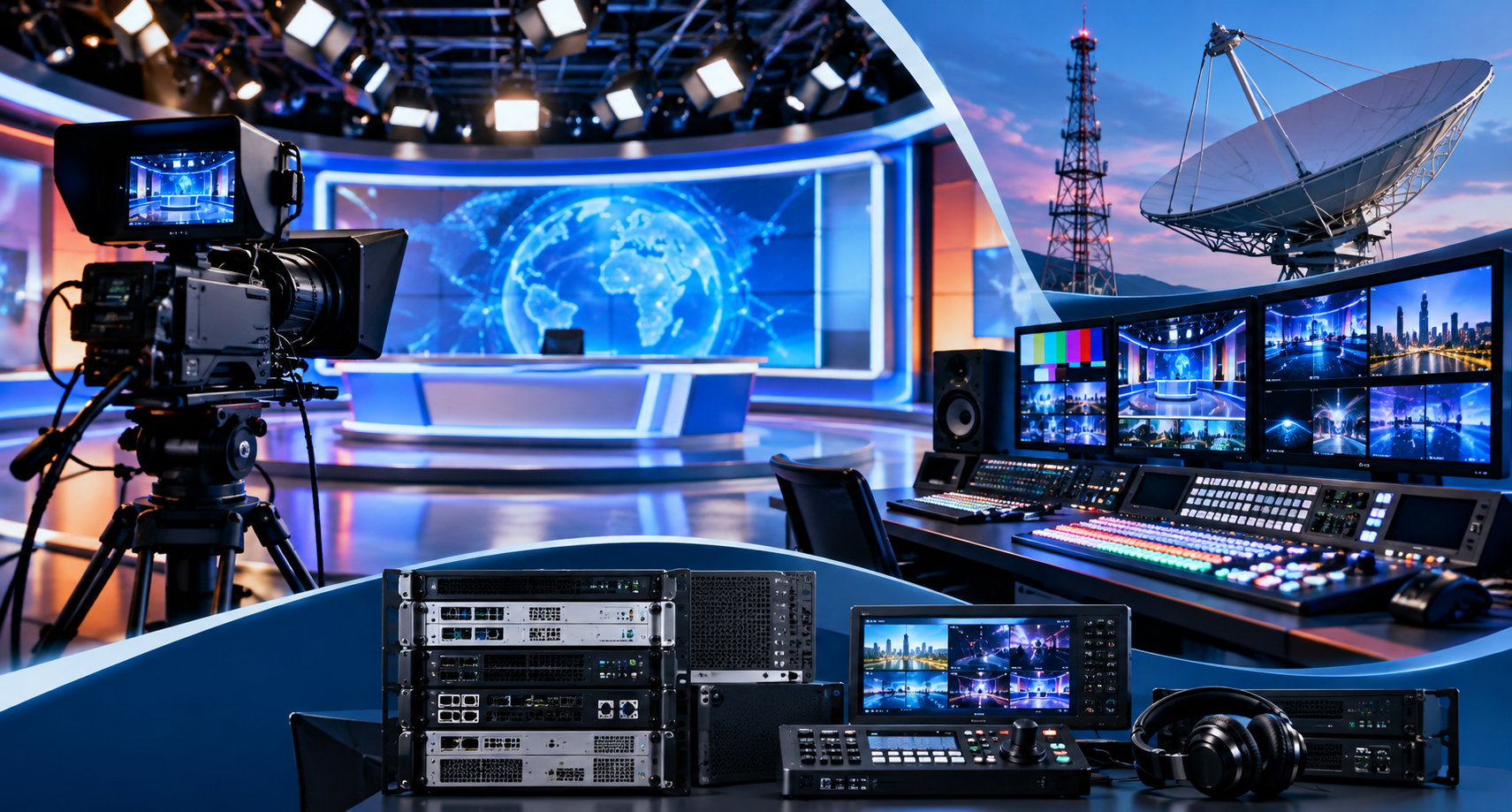
A television facility is not a collection of equipment. It is a signal path, a set of workflows and a group of people, and it works only when all three have been designed together. Sunad Broadcast provides broadcast system integration across India — from a single edit suite to a complete multi-studio channel facility — and we are accountable for the system working, not merely for the boxes arriving.
Our integration team comes from operations. The engineers who design your gallery have sat in one during a live bulletin, which shapes decisions in ways that a purely commercial integrator's do not: where the talkback panels go, how many keystrokes it takes to recover from a failed clip, whether a single engineer can fault-find the chain at two in the morning.
What system integration covers
Consultancy and design
Every project starts with requirements, not equipment. How many hours of original programming per day? Live or pre-recorded? How many simultaneous edit seats? What is the archive retention policy? What is the disaster-recovery expectation — a warm standby, a second site, or an accepted risk?
From those answers we produce a system design: signal-flow diagrams, rack elevations, power and cooling budgets, a network plan, an equipment schedule with named models and quantities, and a phased implementation roadmap. Clients frequently take this design to tender, and we are comfortable with that. A good design is worth paying for on its own.
Studio design and build
Studio work spans civil and technical scope: acoustic treatment and isolation, lighting grid and dimming, HVAC that cools the load without being audible on the floor, cable containment, technical earthing, set design and construction, and the camera, prompter and talkback systems that sit on top.
Acoustics deserve particular emphasis because they cannot be fixed later. A studio with a high noise floor or an untreated flutter echo will sound amateur on every programme it ever produces, and no amount of post-production will repair it. We specify measured noise criteria targets and verify them on commissioning.
Playout and automation
Playout is where a channel lives or dies. We design and integrate integrated channel-in-a-box systems for single and multi-channel operations, traditional discrete playout chains where scale or redundancy demands it, automation linked to traffic and scheduling systems, branding and graphics insertion, subtitle and audio-description insertion, and compliance recording.
Redundancy is a commercial decision rather than a technical one. Main-and-backup playout with automatic changeover roughly doubles the playout capital cost; being off air for four hours during prime time costs advertising revenue, credibility and sometimes a licence conversation. We set out the options and the numbers and let the client choose with full information.
Storage, MAM and archive
Production storage has to sustain a real-world load — several editors working in 4K simultaneously — which makes sustained throughput more important than headline capacity. We size shared storage against the actual number of streams, not against a brochure figure.
Media asset management is the layer most often under-specified and most missed later. Without it, a broadcaster's archive becomes a set of hard drives nobody can search. We implement MAM with a sensible metadata schema, proxy generation, and a nearline-to-LTO archive policy that matches how the content is actually reused.
IP, SDI and networking
We build both. Baseband SDI facilities remain the pragmatic choice at smaller scale, where a router and a patch panel give an engineer something they can see and probe. IP infrastructure using SMPTE ST 2110 or NDI comes into its own at larger scale, across multiple sites, and wherever remote production is part of the plan.
Where we build IP, we build it properly: dedicated media networks rather than a shared corporate LAN, PTP timing designed and verified rather than assumed, non-blocking leaf-spine topology, and a monitoring layer that shows an operator what is flowing where.
Commissioning, training and support
Commissioning is a formal process with a written acceptance test plan, signed off line by line. Handover includes as-built drawings, configuration backups, an equipment register with warranty dates, and written standard operating procedures for the people who will run the facility.
Training matters more than most clients expect. An excellent facility operated by people who were shown it once for an afternoon will underperform a modest facility whose operators understand it. We train operators and engineers separately and leave documentation written for each audience.
Typical projects
News channel facilities — studio, gallery, newsroom computer system, ingest, edit, playout and compliance in one integrated build.
Regional and niche channel launches — lean, automation-led facilities designed for a small operating team.
Corporate and government studios — broadcast-grade rooms for webcasts, training, internal communication and press conferences.
Educational and institutional facilities — teaching studios and content-production centres for universities and training bodies.
Post-production facilities — edit suites, grading rooms, audio suites and the shared storage that connects them.
OB and flyaway systems — mobile production kits for events, sports and field coverage.
Upgrades and migrations — HD to 4K, SDI to IP, tape to file, on-premise to hybrid cloud, executed without taking a live channel off air.
Mistakes we are most often asked to fix
A large share of our integration work is remedial — coming into facilities built by someone else and making them work. The same problems recur.
Equipment bought before the workflow was designed. A client buys cameras and a switcher at a trade show, then discovers the formats do not match the edit system, the storage cannot sustain the streams, or the router has no spare capacity. Design first, purchase second — always.
Power and cooling under-specified. Racks are populated to capacity with no thermal headroom, UPS runtime is calculated for the original load rather than the current one, and the facility becomes unreliable in summer. We calculate power and cooling for the end state plus thirty per cent.
No documentation. Facilities where the only person who understood the wiring has left are common. Without as-built drawings and configuration backups, every fault becomes an investigation. Documentation is not paperwork; it is the difference between a ten-minute fix and a four-hour outage.
Undersized or unstructured cabling. Cable is the cheapest part of a build and the most expensive to replace. We pull generous spare capacity and label both ends of every run to a documented scheme.
Timing treated as an afterthought. In SDI facilities, genlock and timing distribution determine whether sources cut cleanly. In IP facilities, PTP does. Both need designing; neither can be bolted on later.
Security ignored. Broadcast systems increasingly sit on networks, and a playout system reachable from the office LAN is a serious risk. We segment media networks, control remote access properly, and patch on a schedule rather than never.
Operations, staffing and the human side of a facility
The best-designed facility underperforms if the operating model is wrong. We help clients think through what the facility asks of the people who run it.
A 24×7 channel needs enough operators for a four or five-shift rota, not three people working extended hours. An edit facility with six suites needs a media manager, otherwise editors spend their time hunting for files. A studio needs someone who owns the daily technical check, because faults found at 9am are inconvenient and faults found at 9pm are public.
We also design for the skill level that will actually be available. A facility in a metro can assume experienced broadcast engineers; one in a smaller city frequently cannot, and should be built with more automation, simpler recovery procedures and better documentation to compensate. Specifying a system that requires expertise the client cannot recruit is a design failure, not a client failure.
How we work commercially
We quote design, equipment, installation, commissioning and support as separate line items. There are two reasons. First, you can see what you are buying and compare like with like. Second, you are free to buy equipment directly if you have better procurement terms than we do — we will still integrate it and still stand behind the system.
Where a project is phased, we design the end state first and then implement it in stages, so that phase one does not have to be torn out to accommodate phase two. This is the single most common and most expensive mistake we are asked to correct in facilities built by others.
After the build
Integration is the beginning of the relationship, not the end of it. We offer annual maintenance contracts with defined response times, remote monitoring, spares holding, scheduled preventive maintenance and an upgrade path reviewed annually.
Because the same company also produces television programmes and manages channel branding and playout, we understand the facility from the operator's side of the desk as well as the engineer's. If you are planning a studio, launching a channel or trying to modernise a facility that has grown one purchase at a time, start with a conversation about what you need it to do — the equipment list follows from that, not the other way round.
What's included
-
Consultancy and workflow design Requirement capture, signal-flow architecture and phased roadmaps.
-
Studio design and build News, talk and virtual studios with acoustics, lighting and sets.
-
Playout and automation Channel-in-a-box, traffic integration and redundancy design.
-
Storage, MAM and archive Production storage, media asset management and LTO archive.
-
IP and SDI infrastructure SMPTE ST 2110, NDI, routing, timing and network design.
-
Commissioning, training and AMC Handover documentation, operator training and ongoing support.
Let us scope your project
One conversation is usually enough to map deliverables, crew and a realistic delivery date.
Frequently asked questions
What does it cost to set up a television channel in India?
A lean single-studio news channel with a channel-in-a-box playout, three cameras, basic graphics and shared storage typically starts around ₹1.5 to ₹3 crore in capital equipment. A mid-scale facility with two studios, redundant playout, proper MAM and a newsroom system generally lands between ₹5 and ₹12 crore. Uplink, teleport and carriage charges are separate operating costs.
How long does a studio build take?
A single-studio installation usually runs twelve to twenty weeks from contract: three to four weeks of design freeze, six to ten weeks for civil, acoustic and electrical works running in parallel with equipment procurement, three to four weeks of installation and integration, and two weeks of commissioning and training.
Should we build on SDI or IP?
For a facility under roughly twenty sources, SDI remains simpler, cheaper and easier to fault-find, and is a perfectly sound choice today. Beyond that, or where remote production and multi-site working matter, ST 2110 or NDI pays for itself in flexibility. The right answer depends on scale, on the skills of the operations team and on where you expect to be in five years — we will give you a straight recommendation rather than selling the more expensive option by default.
Do you support equipment you did not supply?
Yes. We take on annual maintenance contracts for existing facilities, including mixed-vendor installations, and we are frequently called in to document and stabilise systems whose original integrator is no longer available.
What happens after handover?
Every project is handed over with as-built drawings, signal-flow diagrams, an equipment register with serials and warranties, configuration backups and written operating procedures. Operator and engineer training is included, and support options range from business-hours remote assistance to 24×7 on-site cover for facilities that transmit around the clock.
Let's scope your broadcast system integration project
One call is usually enough to map the deliverables, the crew and a realistic delivery date.